Calling for Help and Digital Aid
About · Calling for Help
Calling for Help is founded and staffed by me, Andrew Campbell. I live in Scotland and have been a paraplegic for over twenty years, following a climbing accident. Since I was injured I’ve travelled the world, and the difference in living standards between people with disabilities in countries like mine and people with disabilities almost anywhere else is stark. The first time I saw a paraplegic dragging themself across the dirt because they had no wheelchair, my first instinct was that the answer was to send wheelchairs. As I looked into it and talked to aid agencies on the ground, I realised that wheelchairs already exist — the problem is distribution, and the agencies struggle to find the people who need them. The refugee with a disability in the back of the camp is invisible to the system trying to deliver the wheelchair to them.
So I came at the problem from where I sit, which is a country with broadband, a working healthcare system, and access to the same AI and APIs the tech industry uses for billions in commercial work. The answer I landed on isn’t a wheelchair shipment. It’s phone credit, sent direct so a refugee with a disability can call the people best suited to help them.
As I learned more about the reality of life for refugees with disabilities, the picture became more shocking. Providing free phone top-ups isn’t a luxury — it’s a life-saving utility most of us take for granted.
These ten countries alone account for 3.86 million refugees with disabilities forced to flee. Wherever they land, as long as a phone tower is reachable, the credit gets to their phone in seconds.
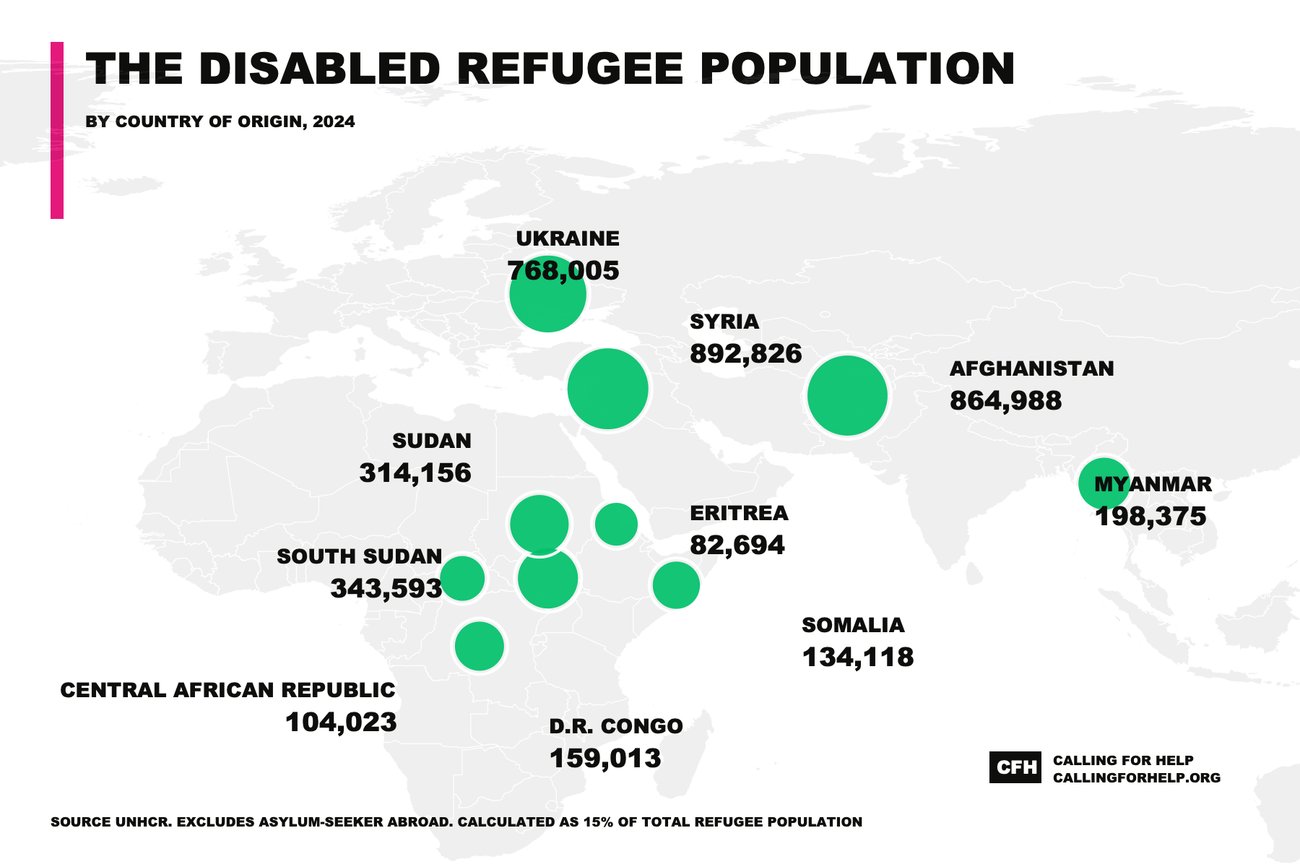
// phone credit · the reach
Where the credit lands
map · UNHCR · cfh ops
Too often, people with disabilities don’t even become refugees. They become dead.
People with disabilities are usually the first to be left behind when disaster hits, and often the first to be killed — not because anyone is openly discriminating, though that happens too, but because there isn’t a plan. Local authorities don’t have one. The neighbours who’d normally help out are busy evacuating their own families. And people with disabilities tend to be poor enough that they can’t afford the phone credit which would have delivered the evacuation alert in time, so the warning never reaches them.
Here’s what I keep coming back to.
There’s no shortage of help available — dedicated, professional aid workers and agencies operate in every camp, with wheelchairs, prosthetics, medical evacuations and family-tracing services all real and mostly free at the point of delivery. The problem isn’t a shortage of aid; it’s that the people who need it most are unreachable.
The line I keep coming back to is this: a phone is more important than a wheelchair. Not because the wheelchair doesn’t matter — it absolutely does — but because the wheelchair is sitting in a warehouse in Cairo, or queued at a UNHCR desk the refugee with a disability can’t reach. A phone with credit is what closes that gap.
Reaching a refugee camp doesn’t mean safety.
The ones who survive the disaster and make it to a camp arrive at the back of the queue for everything — food, water, shelter, registration. Aid distribution points usually aren’t physically accessible to wheelchair users, blind people, or anyone who can’t walk a kilometre or two through soft sand, so refugees with disabilities either miss out altogether or end up paying bribes for help that’s meant to be free, which leaves them poorer than they arrived.
Inside the camp they’re stolen from and abused, and they get lost in the warren of tents — or, in protracted camps, the warren of cinder-block alleys — effectively hidden from the aid agencies that are supposed to be helping them. Outreach teams are stretched thin and built for the median, so the refugee with a disability in the back tent doesn’t make it onto the list, because the list never reaches the back tent.
73% of women with disabilities have experienced gender-based violence in their lifetime (Jimma Town study, Ethiopia, 2022). In refugee camps, that number gets worse — and almost none of those women are ever heard from, because they can’t call for help without a phone.
Phone credit is the first step to every other piece of aid.
A phone with credit isn’t aid in the conventional sense — there’s no truck involved, no warehouse, no shipping container, no distribution point that has to be physically reached. It’s the connection that makes every other piece of aid reachable for someone who can’t reach it themselves. One working phone with five pounds of credit on it lets a refugee with a disability call the UNHCR registration desk that crossed them off the list, the cousin in Abéché who’s been trying to send bus fare, the Humanity & Inclusion clinic that has a wheelchair on her file, the air-raid alert app that goes silent when the data dies.
From a single phone with credit, a refugee with a disability can reach a UN agency for resettlement, a clinic for a prosthetic appointment, a remittance agent for a money transfer that’s been queued for weeks, a family member they haven’t spoken to since the bombs fell, a screen reader to read the food-distribution list aloud, an air-raid app to know whether to move. All of those connections happen on a phone with credit. The infrastructure to deliver it already exists.
Here’s how it actually works.
The entire project runs digitally, from an application from a refugee through to the credit being sent to their phone — no expensive deployments, no shipping physical aid packages, no mass distribution system. AI agents handle the application in seconds, a bank-grade biometric check verifies the person is who they say they are, the application is screened for fraud and risk at the same level any international bank transfer is, and a human signs off every payout before the credit lands directly on the recipient’s phone in seconds across 180+ countries. Digital humanitarian aid, closing the disability gap one verified person at a time — anywhere a tower stands.
The most efficient and cost-effective way to help.
Phone credit is cheap to deliver, lands on the recipient’s phone in seconds, and bypasses the warehouse-and-queue logistics that traditional aid relies on. Almost every pound goes to airtime — application to delivery in roughly two minutes. The recipient is the one deciding what to use the credit for: a call to family across a closed border, an evacuation alert app, a doctor’s appointment, a money transfer that’s been queued for weeks, a screen reader to read aloud the food-distribution list. The choice is theirs to make, and that’s the dignity built into the model.
// once a month · free · no fundraising spam
Refugees with disabilities go unheard. Not in your inbox.
The Field Notes is our monthly dispatch from inside the work — what £5 of credit reached, what it unlocked, who’s still waiting.
unsubscribe with one click · we never sell your email