122 million people are displaced. 16 million of them have a disability. The system can’t see them.
Hussein Ahmad’s 17-year-old son was shot in the neck fleeing Myanmar in 2017 — paralysed from the waist down. He has a wheelchair he can’t use, on Cox’s Bazar tracks too steep for it. Bangladesh bars Rohingya from local SIM cards. 17.6 million displaced people are like him — disabled, displaced, and missing from almost every system designed to reach them.
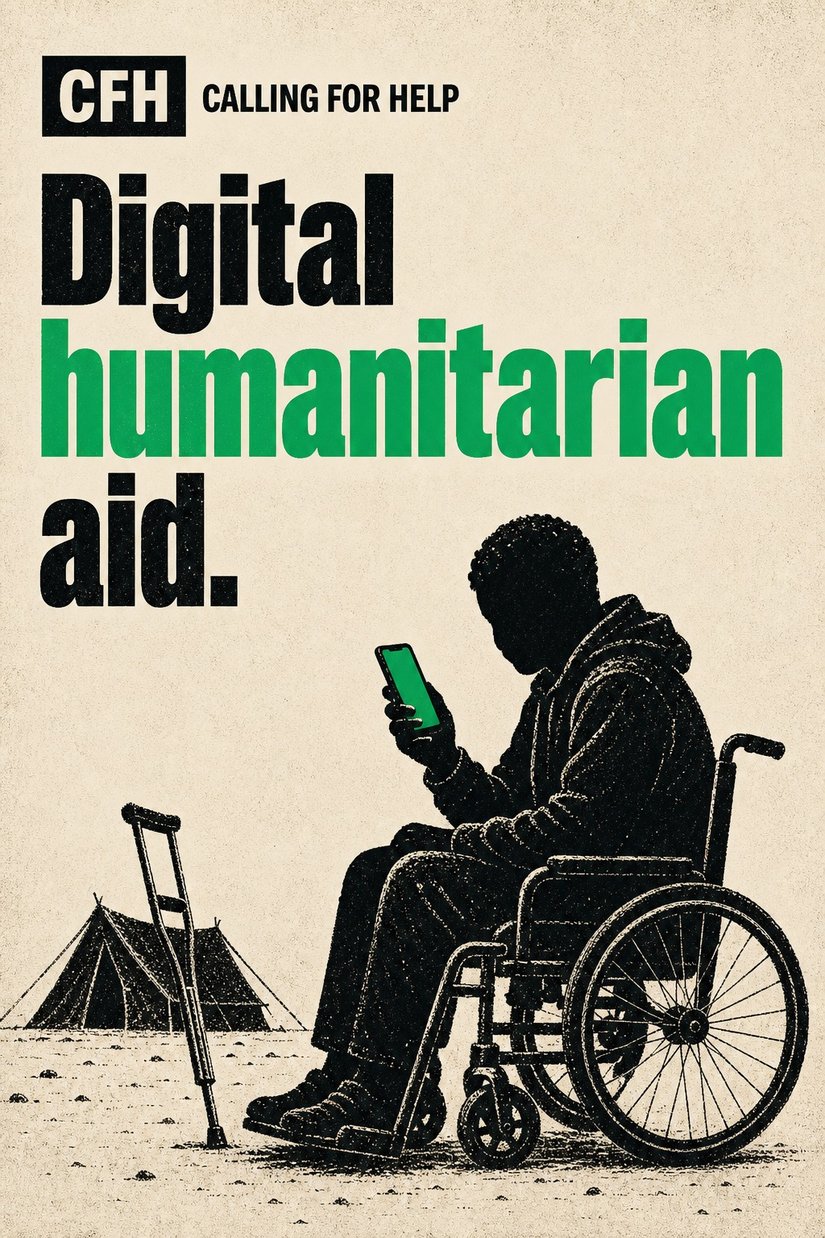
A refugee with a disability uses a phone in a refugee camp.
Why do we use Ai images? We don’t use photos of refugees with disabilities — their dignity, identity and safety come first. We’re powered by Ai and don’t spend funds on royalty payments for photos of refugees taken while in crisis.
People with disabilities don’t become refugees. They become invisible.
Without a working phone in your pocket, you stop existing in the data.
Hussein Ahmad’s 17-year-old son was shot in the neck fleeing Myanmar in 2017 — paralysed. He has a wheelchair but Cox’s Bazar’s tracks are too steep. ‘His life is being destroyed in front of me,’ his father told HRW. Bangladesh bars Rohingya from owning SIM cards. Over 12,000 phones have been confiscated since 2019.
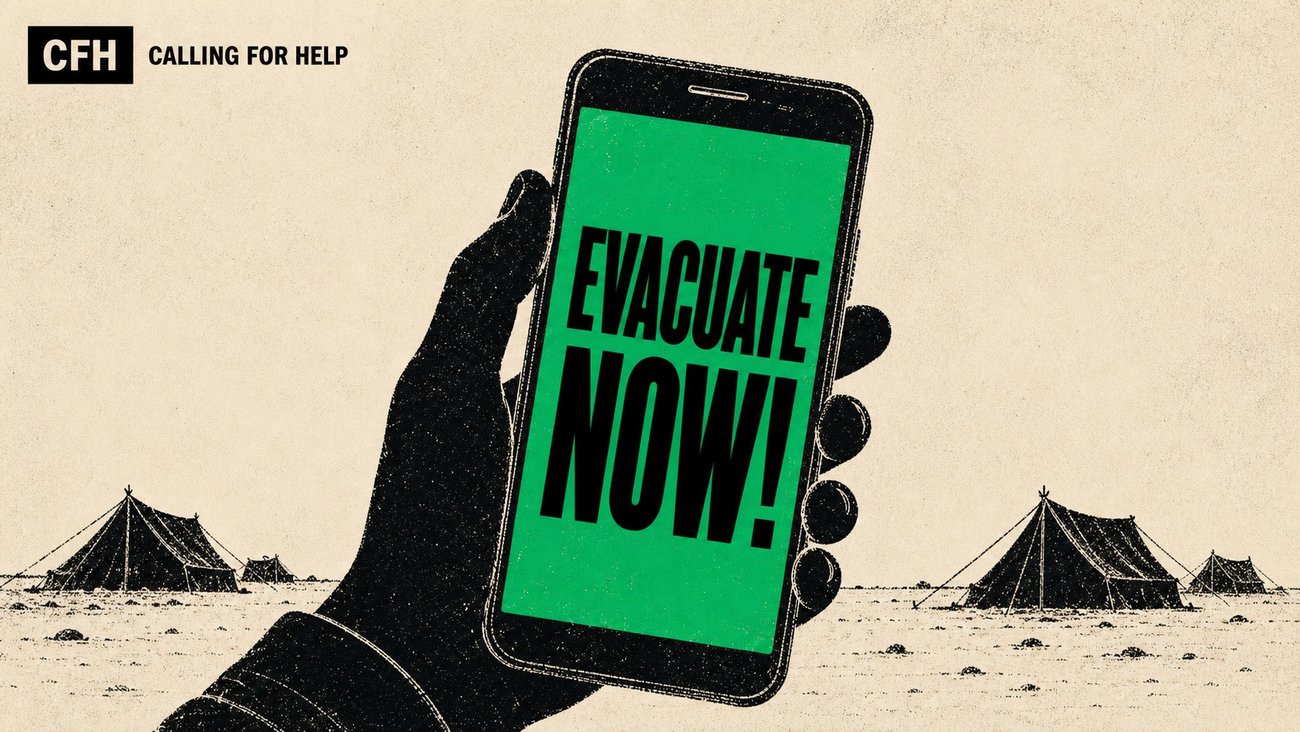
A hand holds a phone showing EVACUATE NOW! in heavy green block letters.
Why do we use Ai images? We don’t use photos of refugees with disabilities — their dignity, identity and safety come first. We’re powered by Ai and don’t spend funds on royalty payments for photos of refugees taken while in crisis.
Sami, a young Syrian refugee, lost both legs in the conflict and reached Zaatari camp in Jordan. Mercy Corps’ adaptive workshop built him a hand-pedal racing chair. He won his division at a 10K hand-cycle race in Amman. In Zaatari, GSMA found 86% of young refugees own a phone — most can’t afford credit.
Elkhansa is a Sudanese refugee in Cairo, born without hands; she draws and writes with her feet. ‘I never covered my arm, I wanted people to see me for who I am, a proud woman.’ She runs the Arab Young Women with Disabilities organisation she founded — by phone. (UNHCR Egypt, 2024.)
Every day another phone falls silent in another camp, in another country, and another refugee with a disability disappears from the only systems that could still find them. From Cox’s Bazar to Kharkiv, connection is protection.
There’s a digital disability gap. We close it with just £5.
People with disabilities are pushed to the back of every queue — physical and digital — in every camp, transit centre, urban displacement, and protracted refugee situation on Earth. Lost mobility aids, destroyed roads, queues they can’t stand in, registration desks they can’t reach. They shouldn’t face a digital barrier on top of every other one. Without phone credit, every system that could still find them is out of reach — registration, doctors, family transfers, prosthetists, the WFP food card, an interpreter on the other end of a video call. A phone is the first step back into the count.
The best way to make people less poor is to give them money.
The best way to help refugees with disabilities is to give them phone credit.
So that’s what we do. Free mobile credit, direct to the phone of a verified refugee with a disability, one person at a time. Anywhere a tower stands. Within minutes.
This is how we send Digital Humanitarian Aid to refugees with disabilities, one person at a time.
- AI triages every application. Hundreds screened in seconds. The same kind of model big firms use to catch fraud — pointed at finding the people who need help. No team of caseworkers needed, so more of every £5 reaches the recipient.
- Banks-grade biometric ID check. Sub-three-second liveness scan, catches deepfakes and replay attacks. The same standard banks use to open an account.
- Disability confirmed by the WHO standard. The global medical-aid methodology — the same questions the UN uses to count refugees with disabilities.
- Cleared against UK, EU, UN and OFAC sanctions databases. Every applicant, every time. The same list your bank checks before sending a transfer.
- A human gives final approval on every payout. Then the credit lands on the recipient’s phone in seconds — anywhere a tower stands, in 180+ countries. From approval to delivery of a lifeline in under 2 minutes.
Phone credit is more important than a wheelchair.
Aid is in short supply almost everywhere refugees with disabilities are. What does get through can’t reach everyone — and the people aid workers can’t physically find are the ones with the disabilities, every time. A working phone is the connection that brings them back into reach. The £5 we send becomes the call that puts one refugee with a disability back in front of every aid system, every doctor, every family member, and every agency holding the wheelchair, prosthetic, or assistive device ready to be delivered. From Cox’s Bazar to Kharkiv, the unit of progress is one person at a time.
£5 in phone credit is the most effective humanitarian aid.
We’re finding one refugee with a disability at a time across the world — the people other systems miss — and reaching them directly. The newsletter tells more of their story.
Read what £5 just unlocked.
One phone with credit is the cheapest disability-inclusive aid in the world. They need it now.
A working phone with credit isn’t aid in the usual sense. It’s the first move — the connection that makes every other piece of aid reachable. From Cox’s Bazar to Kharkiv, from Adré to Tawila to Nyumanzi, here’s what one phone unlocks:
- In Cox’s Bazar, where Bangladesh bars Rohingya from local SIM cards and authorities have confiscated 12,000+ phones since 2019 (HRW), connectivity is a daily fight — and disabled Rohingya pay first.
- In Zaatari camp, Jordan, where 86% of young refugees own a phone but most can’t afford credit (GSMA Digital Lives of Refugees, 2019), £5 of credit is the difference between owning a brick and being reachable.
- In Cairo, where 500,000+ Sudanese refugees include people like Elkhansa, who runs her disability organisation by phone (UNHCR Egypt, 2024), credit is what powers an organiser’s outreach across a sprawling city.
- In Lebanon’s Bekaa Valley, where 7-year-old Dalal didn’t leave her family’s tent for 18 months until HI provided a wheelchair (HI, 2014), a phone with credit reaches the next assistive-device referral by SMS.
- In Vecsés, Hungary, where 4-year-old Murat lost his refugee accommodation and faces phased-out cash assistance after going deaf from meningitis (UNHCR Europe, 2024), a phone with credit keeps a deaf child’s family in contact.
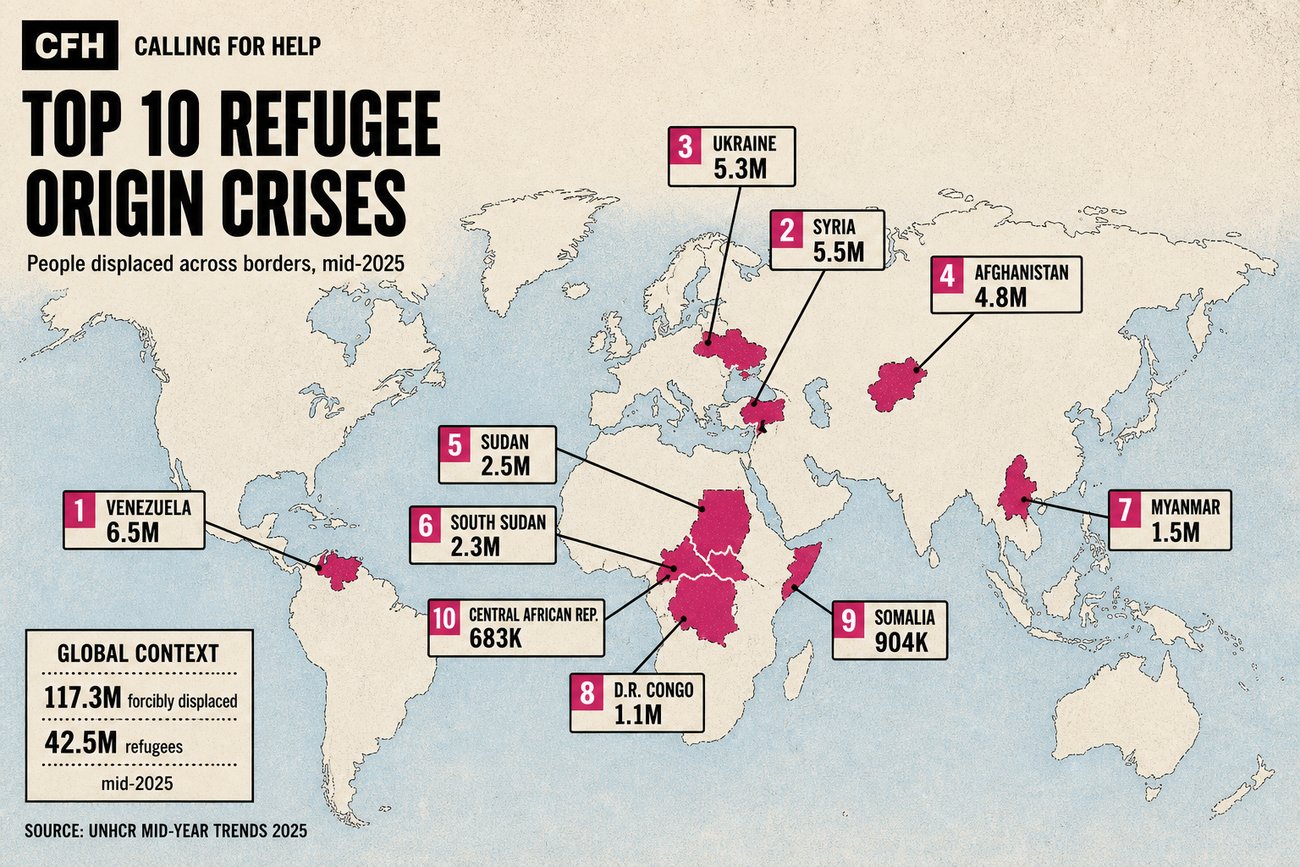
World map showing the top 10 refugee origin crises in mid-2025 — Venezuela 6.5M, Syria 5.5M, Ukraine 5.3M, Afghanistan 4.8M, Sudan 2.5M, South Sudan 2.3M, Myanmar 1.5M, DR Congo 1.1M, Somalia 904K, Central African Republic 683K, with global totals of 117.3M forcibly displaced and 42.5M refugees.
Why do we use Ai images? We don’t use photos of refugees with disabilities — their dignity, identity and safety come first. We’re powered by Ai and don’t spend funds on royalty payments for photos of refugees taken while in crisis.
Right now, there’s a list of refugees with disabilities waiting for credit, in dozens of countries. We’re working through it. Will you help us reach the next one?
Refugees with disabilities go unheard. Not in your inbox.
The Field Notes is our monthly dispatch from inside the work. Subscribing is the first way to stand with them.
- What £5 of credit reached, and what it unlocked for one verified person
- Live ops view — who we found, who’s still waiting
- First to know the moment donations open
No spam. Unsubscribe any time. We never share your data.
Help us close the digital divide one person at a time.