Disabled LGBTQ+ refugees flee the death penalty at home and find it again in the camp.
Andrey Samstov, deaf and gay, was arrested after a 2011 Moscow Pride protest, his father threatening to kill him repeatedly. He sought asylum in Canada. 64 UN member states still criminalise being LGBTQ+. Uganda’s 2023 Anti-Homosexuality Act explicitly names disability as an aggravating factor — same-sex contact with a person with a disability carries the death penalty. Rainbow Railroad received 13,402 requests for help in 2024.
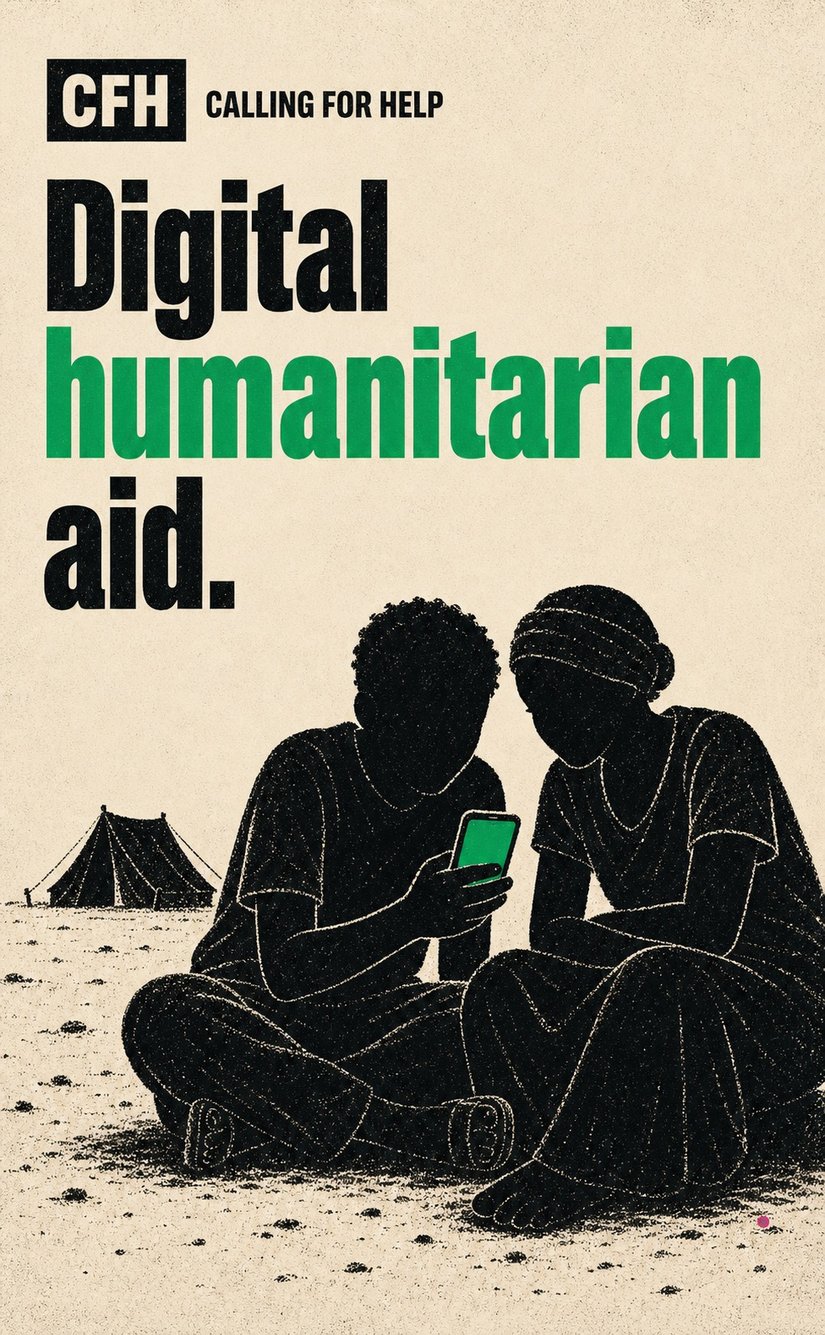
Two friends sit together in a refugee camp, one uses a phone.
Why do we use Ai images? We don’t use photos of disabled refugees — their dignity, identity and safety come first. We’re powered by Ai and don’t spend funds on royalty payments for photos of refugees taken while in crisis.
Disabled LGBTQ+ refugees don’t become refugees. They become hidden.
Without a phone connection their odds of getting help are bleak.
Andrey Samstov, deaf and gay, was arrested after a 2011 Moscow Pride protest. His father threatened to kill him repeatedly. When he tried to report the threats: ‘because of my deaf issue and my gay issue, they completely ignored my request for help.’ He flew to Canada in August 2013. (Global News.)
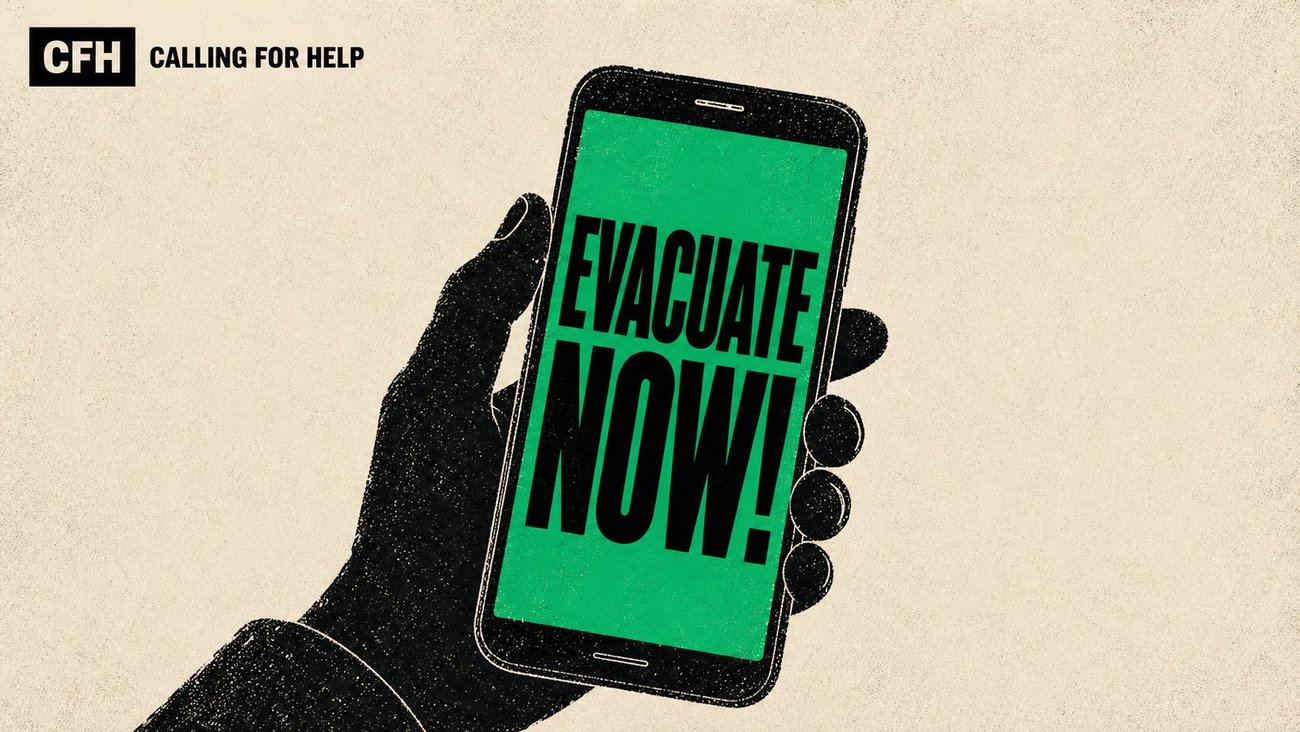
A hand holds a phone showing EVACUATE NOW! in heavy green block letters.
Why do we use Ai images? We don’t use photos of disabled refugees — their dignity, identity and safety come first. We’re powered by Ai and don’t spend funds on royalty payments for photos of refugees taken while in crisis.
Layla Al Darwish, a functionally blind trans woman in Saudi Arabia, contacted Trans Rescue. Her father ‘threatened to kill her.’ Six brave people coordinated her evacuation through Georgia in 2022 — communicating with her by screen-reader-equipped phone before extraction. (Trans Rescue, 2023.)
Kim Kads, 26, a trans woman from Uganda, was attacked outside a club in Rongai, Kenya. Her assailants beat her, destroyed her phone, and demanded she leave town. She later reached an LGBTQ+ shelter housing 11 other Ugandans. The phone was her connection to that shelter. (Context / Thomson Reuters Foundation, 2025.)
Every day another queer or trans refugee with a disability disappears further into the place they fled to. Every day the credit doesn’t land, another door closes. For disabled LGBTQ+ refugees, connection is protection.
There’s a digital disability gap. We close it with just £5.
LGBTQ+ refugees with disabilities are the population humanitarian systems are least set up to find. They cannot disclose to a registration officer who might out them. They cannot ask a camp neighbour for help. They cannot use the queue that everyone else queues in — sometimes because they’re disabled, sometimes because being seen in a queue would identify them, often both. They shouldn’t face a digital barrier on top of every other one. But without phone credit, every legal aid line, every encrypted hotline, every queer-friendly clinic, every Rainbow Railroad caseworker is out of reach. A phone call is the first step to safety and support.
The best way to make people less poor is to give them money.
The best way to help disabled refugees is to give them phone credit.
So that’s what we do. Free mobile credit, direct to the phone of a verified disabled refugee, one person at a time. Anywhere a tower stands. Within minutes.
This is how we send Digital Humanitarian Aid to disabled refugees, one person at a time.
- AI triages every application. Hundreds screened in seconds. The same kind of model big firms use to catch fraud — pointed at finding the people who need help. No team of caseworkers needed, so more of every £5 reaches the recipient.
- Banks-grade biometric ID check. Sub-three-second liveness scan, catches deepfakes and replay attacks. The same standard banks use to open an account.
- Disability confirmed by the WHO standard. The global medical-aid methodology — the same questions the UN uses to count disabled refugees.
- Cleared against UK, EU, UN and OFAC sanctions databases. Every applicant, every time. The same list your bank checks before sending a transfer.
- A human gives final approval on every payout. Then the credit lands on the recipient’s phone in seconds — anywhere a tower stands, in 180+ countries. From approval to delivery of a lifeline in under 2 minutes.
Phone credit is more important than a wheelchair.
Aid is rarely set up to find LGBTQ+ disabled people. Camps don’t ask. Forms don’t ask. The people who would help — Rainbow Railroad, ORAM, HIAS, MicroRainbow, MSF, the local queer-led group that runs a Signal hotline — exist on phones, not on field-office maps. A working phone is the connection that brings a disabled queer or trans refugee back into reach without having to out themselves to anyone in their immediate vicinity. The £5 we send becomes the call that puts one disabled LGBTQ+ refugee back in front of every system that was trying to find them.
£5 in phone credit is the most effective humanitarian aid.
We’re finding one disabled LGBTQ+ refugee at a time across the world — the people other systems miss, the people who can’t show up at a registration tent — and reaching them directly. The newsletter tells more of their story.
Read what £5 just unlocked.
A phone is the only door they can open in private. It needs credit.
A working phone for a disabled LGBTQ+ refugee isn’t aid in the usual sense — it’s the door they can open without being seen opening it. From Kakuma to Tijuana, from Berlin to Beirut, it’s the connection that makes every other piece of help reachable. Here’s what one phone can do:
- In Kakuma camp, Kenya, where 88% of LGBTQ+ asylum seekers reported being denied police help and 100% of trans residents have been physically assaulted (Rainbow Railroad / ORAM, 2021), a phone with credit is the only working emergency channel.
- In Egypt, where HRW documented 45 LGBTQ+ arrests with phones searched in 100% of cases and digital evidence often fabricated by police (HRW, 2023), encrypted messaging on a credit-loaded phone separates visibility from survival.
- In Beirut, where Mosaic’s LGBTQ+ hotline receives ~100 calls daily during Lebanon’s 2024-26 displacement crisis (Reuters, 2026), a phone with credit is the entry point to the only LGBT shelter in the country.
- In transit through Georgia, where blind trans refugees like Layla Al Darwish were evacuated from Saudi Arabia by phone-coordinated networks (Trans Rescue, 2023), a screen-reader on a credit-loaded phone is the rescue channel.
- In Uganda, where the 2023 Anti-Homosexuality Act names disability as an aggravating factor for the death penalty (HRW, 2024), a credit-loaded phone reaches Rainbow Railroad before the police do.
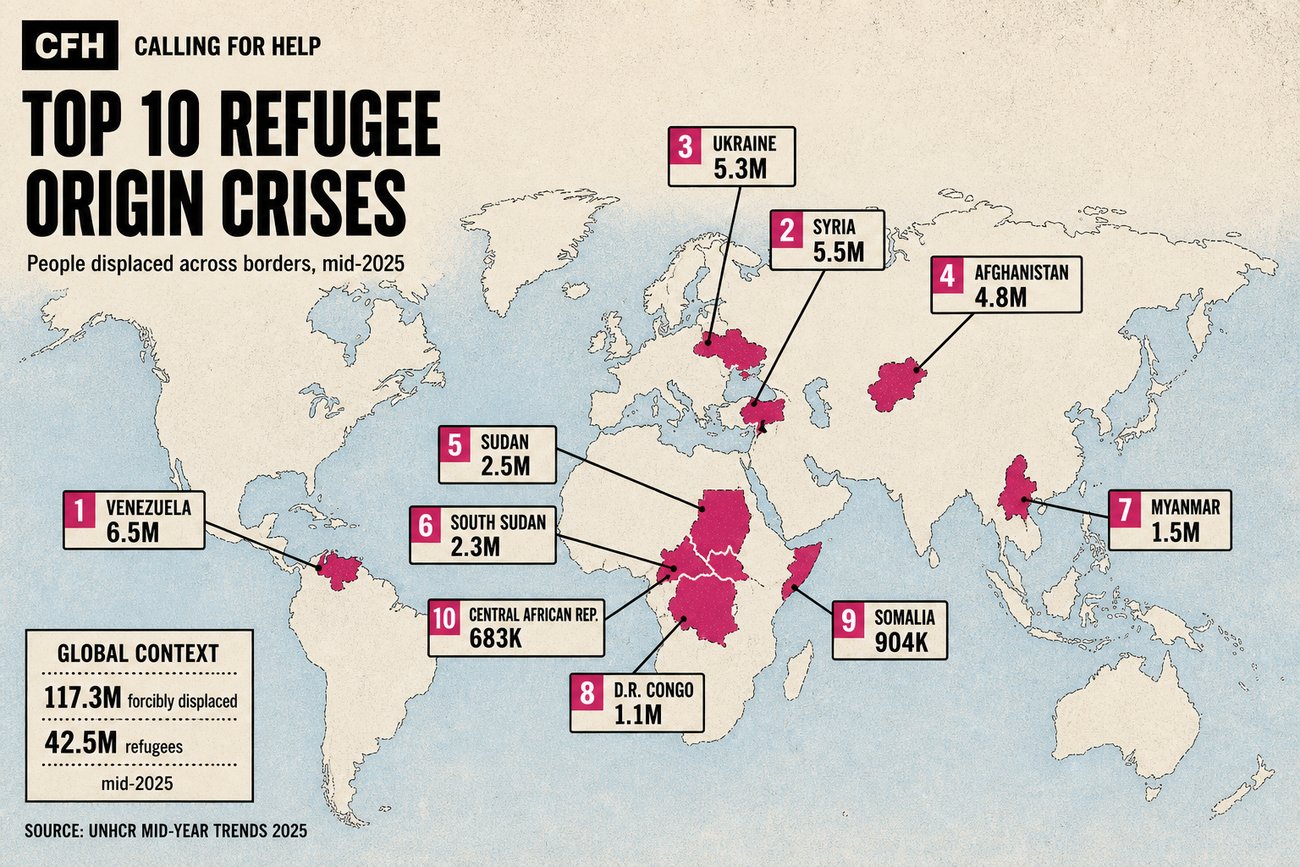
World map showing the top 10 refugee origin crises in mid-2025 — Venezuela 6.5M, Syria 5.5M, Ukraine 5.3M, Afghanistan 4.8M, Sudan 2.5M, South Sudan 2.3M, Myanmar 1.5M, DR Congo 1.1M, Somalia 904K, Central African Republic 683K, with global totals of 117.3M forcibly displaced and 42.5M refugees.
Why do we use Ai images? We don’t use photos of disabled refugees — their dignity, identity and safety come first. We’re powered by Ai and don’t spend funds on royalty payments for photos of refugees taken while in crisis.
Right now, there’s a list of disabled LGBTQ+ refugees waiting for credit — in Kakuma, in Cairo, in Tijuana, in cities that don’t have a camp. We’re working through it. Will you help us reach the next one?
Disabled refugees go unheard. Not in your inbox.
The Field Notes is our monthly dispatch from inside the work. Subscribing is the first way to stand with them.
- What £5 of credit reached, and what it unlocked for one verified person
- Live ops view — who we found, who’s still waiting
- First to know the moment donations open
No spam. Unsubscribe any time. We never share your data.
Help us close the digital divide one person at a time.