Russia targets the grid, then the towers. Ukraine’s disabled refugees lose the only system that could still find them.
On 14 January 2023 a Russian Kh-22 missile hit a Dnipro apartment block, killing 46. Kateryna Zelenska, 27 and deaf since childhood, was trapped under the rubble for nearly twenty hours and used the smartwatch on her wrist to tell her mother she was alive. 36,000 deaf Ukrainians depend on text alerts to know an air raid is coming. They need a phone they can read.
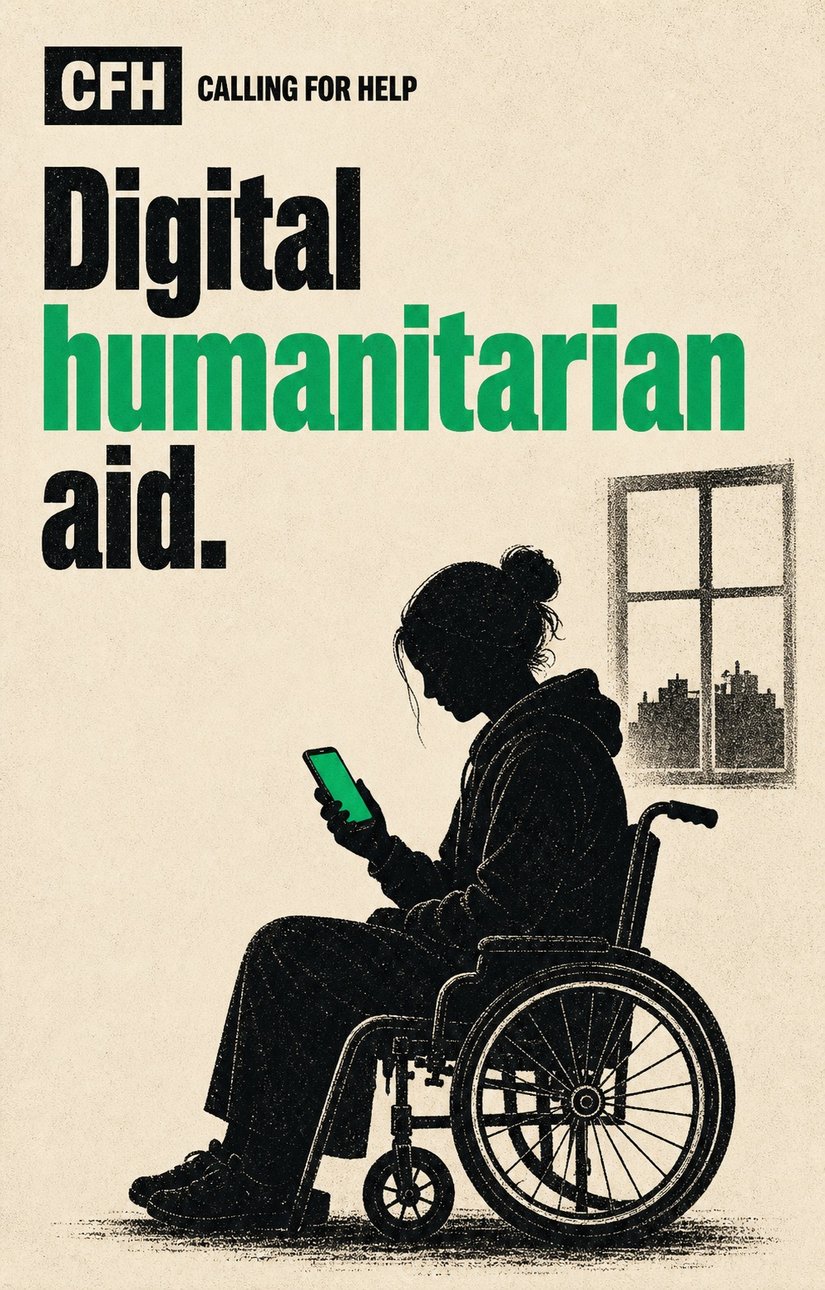
A Ukrainian woman in a wheelchair uses a phone in her apartment.
Why do we use Ai images? We don’t use photos of disabled refugees — their dignity, identity and safety come first. We’re powered by Ai and don’t spend funds on royalty payments for photos of refugees taken while in crisis.
Too often, disabled people don’t become refugees. They become dead.
Without a phone connection their odds of getting help are bleak.
Natalia, a deaf woman in Mykolaiv, woke at 4am one morning in 2022. ‘I looked at the internet. People sent me messages: Are you alive?’ — a rocket had hit the neighbouring 9-storey building. Her smartphone is her only access to air-raid alerts; Ukrainian state TV runs no captions or sign language. (International Disability Alliance, 2022.)
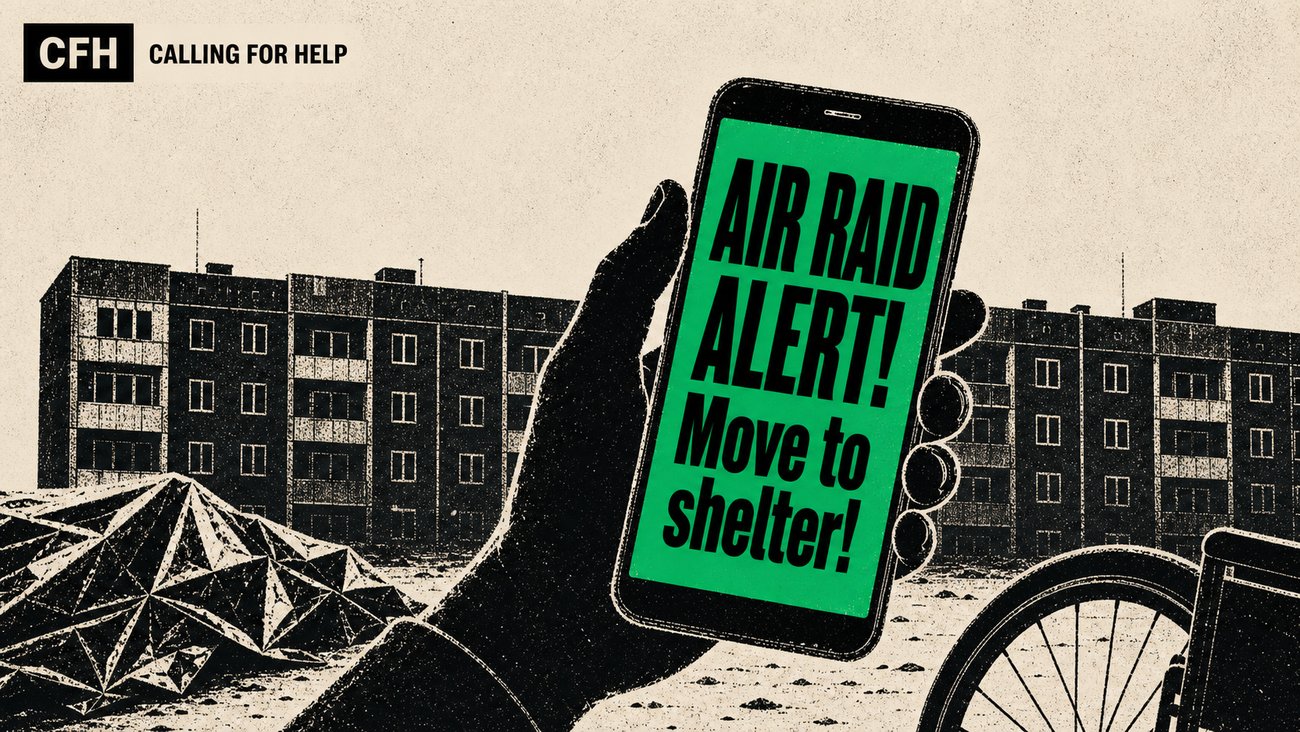
A hand holds a phone showing AIR RAID ALERT! Move to shelter! in heavy green block letters with a Soviet-era apartment block silhouette behind.
Why do we use Ai images? We don’t use photos of disabled refugees — their dignity, identity and safety come first. We’re powered by Ai and don’t spend funds on royalty payments for photos of refugees taken while in crisis.
Kateryna Zelenska, 27, deaf since childhood, was trapped under the rubble of a Dnipro apartment block for nearly twenty hours after a Russian Kh-22 missile strike on 14 January 2023. She used the smartwatch on her wrist to tell her mother she was alive. (WHO Europe, 2023.)
Iryna Mykhailivna, 83, lives in Kryvyi Rih. Russia’s winter 2026 energy offensive has knocked the lift out for days at a time. ‘I’m afraid I won’t be able to contact my relatives or call an ambulance,’ she told ABC News in February. The phone is the last bridge — and it depends on power, signal, and credit.
Every day another phone falls silent in Ukraine. Every day another disabled refugee gets pushed further down the queue, and into more peril. For disabled refugees, connection is protection.
There’s a digital disability gap. We close it with just £5.
Disabled people in Ukraine are pushed to the back of every queue, physical and digital. Inaccessible bomb shelters, evacuation orders that arrive by SMS to phones with no signal, lost mobility aids, kilometres of broken road, the daily blackout that drains every powered chair and hearing aid. They shouldn’t face a digital barrier on top of every other one. But without phone credit, every system that could still find them is out of reach — air-raid apps, evacuation coordinators, doctors, family transfers, prosthetists, banks, the UNHCR resettlement SMS. A phone call is the first step to safety and support.
The best way to make people less poor is to give them money.
The best way to help disabled refugees is to give them phone credit.
So that’s what we do. Free mobile credit, direct to the phone of a verified disabled refugee, one person at a time. Anywhere a tower stands. Within minutes.
This is how we send Digital Humanitarian Aid to disabled refugees, one person at a time.
- AI triages every application. Hundreds screened in seconds. The same kind of model big firms use to catch fraud — pointed at finding the people who need help. No team of caseworkers needed, so more of every £5 reaches the recipient.
- Banks-grade biometric ID check. Sub-three-second liveness scan, catches deepfakes and replay attacks. The same standard banks use to open an account.
- Disability confirmed by the WHO standard. The global medical-aid methodology — the same questions the UN uses to count disabled refugees.
- Cleared against UK, EU, UN and OFAC sanctions databases. Every applicant, every time. The same list your bank checks before sending a transfer.
- A human gives final approval on every payout. Then the credit lands on the recipient’s phone in seconds — anywhere a tower stands, in 180+ countries. From approval to delivery of a lifeline in under 2 minutes.
Phone credit is more important than a wheelchair.
Aid is in short supply across Ukraine, and what does get through can’t reach everyone — least of all the people who can’t make it down to the metro shelter, can’t ride the evacuation bus, can’t push through to the front of a queue. Disabled people are always at the back of the queue — the ones aid workers can’t physically find. A working phone is the connection that brings them back into reach. The £5 we send becomes the call that puts one disabled refugee back in front of every aid system, every doctor, every family member, and every agency holding the wheelchair, prosthetic, or assistive device ready to be delivered.
£5 in phone credit is the most effective humanitarian aid.
We’re finding one disabled refugee at a time across Ukraine — the people other systems miss — and reaching them directly. The newsletter tells more of their story.
Read what £5 just unlocked.
One phone with credit unlocks every aid system around them. They need it right now.
A working phone with credit isn’t aid in the usual sense — it’s the first move. From a Kyiv stairwell to a Lviv hostel, from Kharkiv to Warsaw, it’s the connection that makes every other piece of aid reachable. Here’s what one phone can do:
- In Kamianske, a city of 200,000 with zero wheelchair-accessible bomb shelters (Inkstick / TIME, 2022), a wheelchair user with credit can coordinate evacuation by phone — the only safety strategy available.
- In Mykolaiv, where deaf residents like Natalia rely on smartphone air-raid apps because state TV runs no captions (IDA, 2022), a credit-loaded phone is the only warning system that works.
- In Kryvyi Rih, where 800,000+ households went without power in early 2026 (ABC News), a charged handset with credit is the last bridge to an ambulance when the lift dies and the grid goes.
- In Bucha, where wheelchair users like Uliana Pcholkina turned Facebook posts into rescue beacons during the 2022 occupation (New Mobility), a phone with credit lets disabled residents tell the outside world they’re alive.
- In Chernihiv, where 61-year-old Liudmyla Zhernosek and her amputee husband told Amnesty ‘nobody told us about evacuations,’ a phone with credit is the difference between an order existing and an order being received.
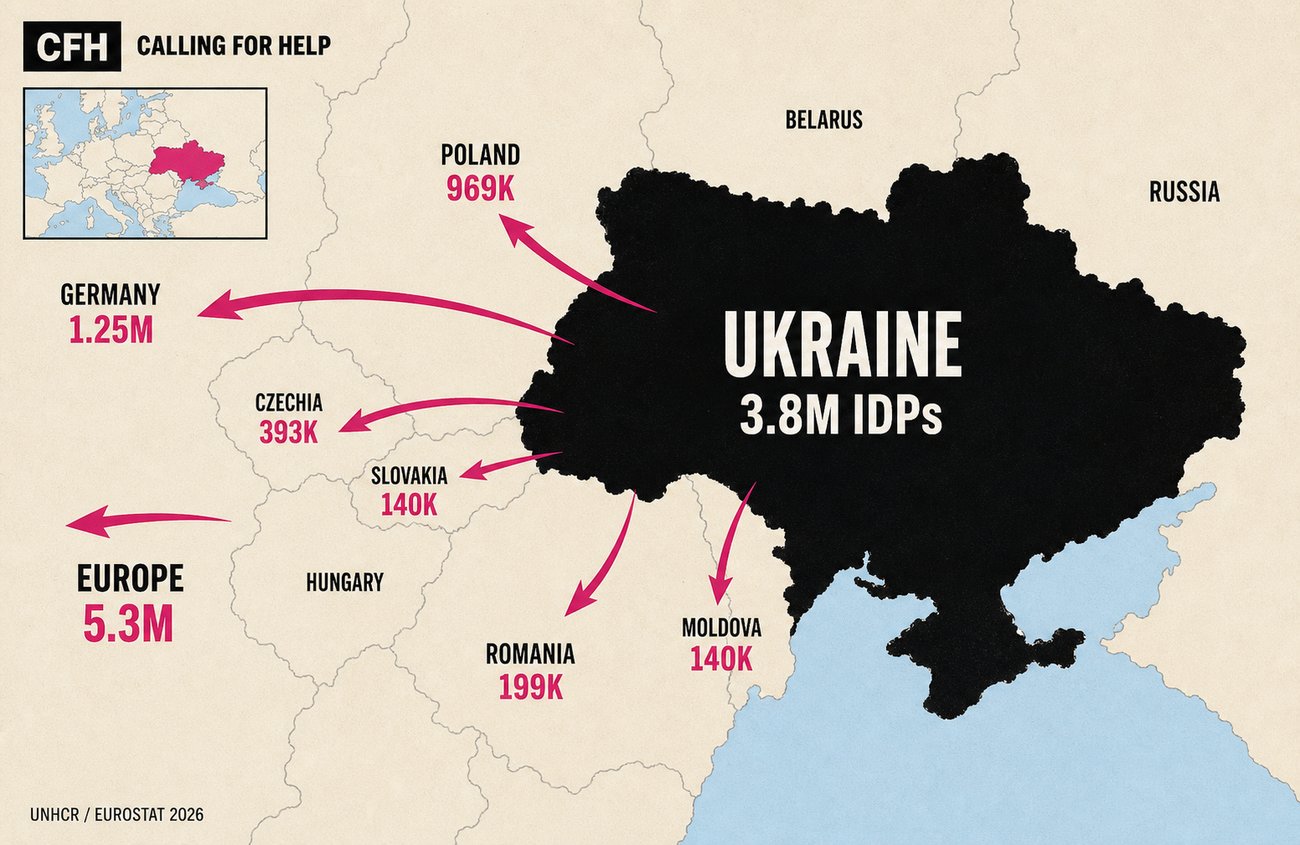
A regional map of Ukraine and its neighbours showing displaced-population outflows: Poland 1M, Germany, Czechia, Romania, Slovakia, Hungary, Moldova, with 3.7M IDPs inside Ukraine and front-line oblasts highlighted.
Why do we use Ai images? We don’t use photos of disabled refugees — their dignity, identity and safety come first. We’re powered by Ai and don’t spend funds on royalty payments for photos of refugees taken while in crisis.
Right now, there’s a list of disabled refugees in Ukraine waiting for credit. We’re working through it. Will you help us reach the next one?
Disabled refugees go unheard. Not in your inbox.
The Field Notes is our monthly dispatch from inside the work. Subscribing is the first way to stand with them.
- What £5 of credit reached, and what it unlocked for one verified person
- Live ops view — who we found, who’s still waiting
- First to know the moment donations open
No spam. Unsubscribe any time. We never share your data.
Help us close the digital divide one person at a time.