Disabled women refugees face violence on every side. The phone in her pocket can’t fight back without credit.
Olha Chernozhukova, 32 and a wheelchair user, sheltered in a basement during Russia’s bombardment of Sievierodonetsk and reached out for emergency help via Telegram. The phone was the literal lifeline. In lower-income countries 22% of women live with a disability — versus 14% of men — and disabled women are 2-4 times more likely to face intimate-partner violence than non-disabled women. Most don’t have credit on the day it happens.
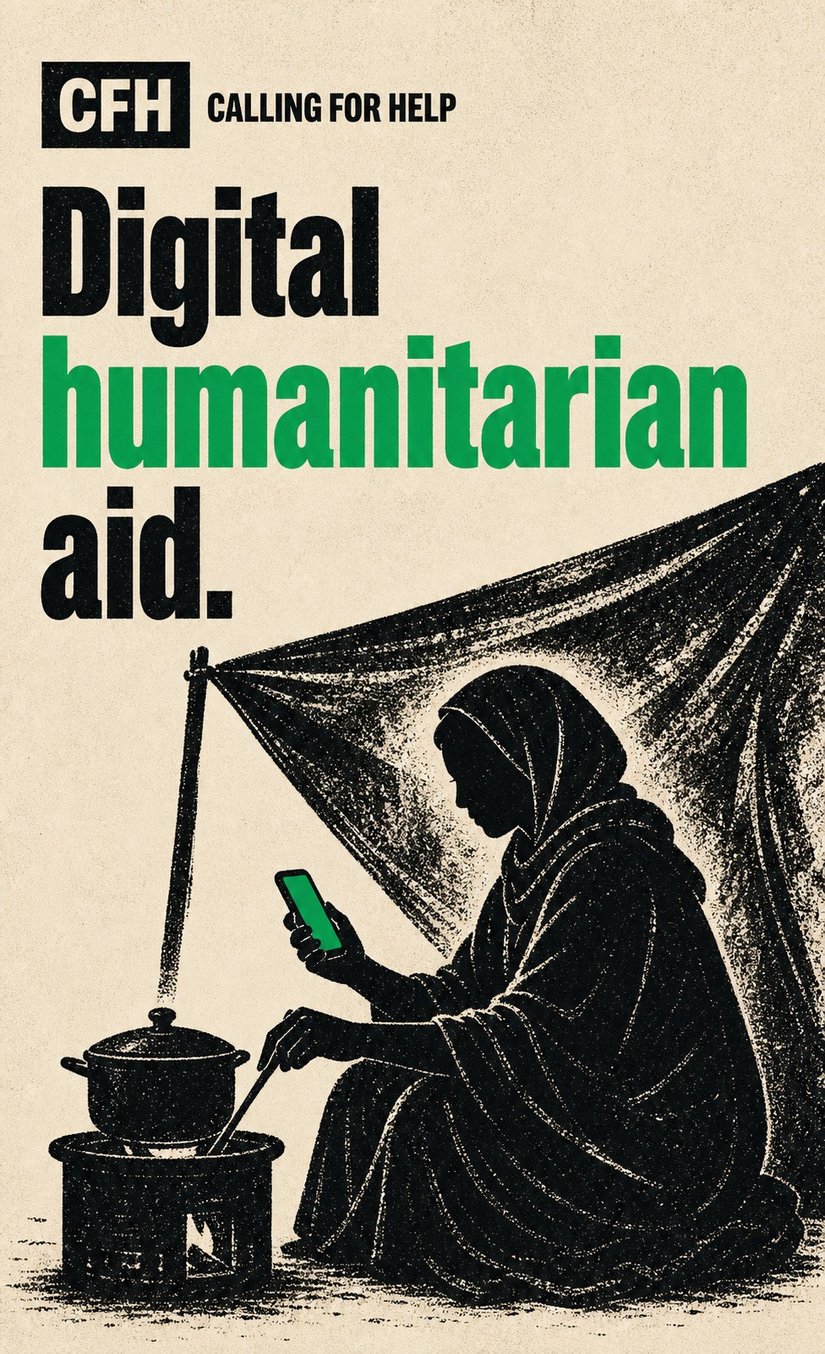
A woman refugee under a tarp uses a phone as she cooks on a small stove.
Why do we use Ai images? We don’t use photos of disabled refugees — their dignity, identity and safety come first. We’re powered by Ai and don’t spend funds on royalty payments for photos of refugees taken while in crisis.
Disabled women refugees don’t escape the war. They face a second one.
Without a phone connection their odds of getting help are bleak.
Olha Chernozhukova, 32, a wheelchair user, sheltered in a basement during Russia’s bombardment of Sievierodonetsk in 2022. She reached out for emergency help via Telegram from the bomb shelter — and that message led to her evacuation. The phone was the literal lifeline. (UNHCR Ukraine.)
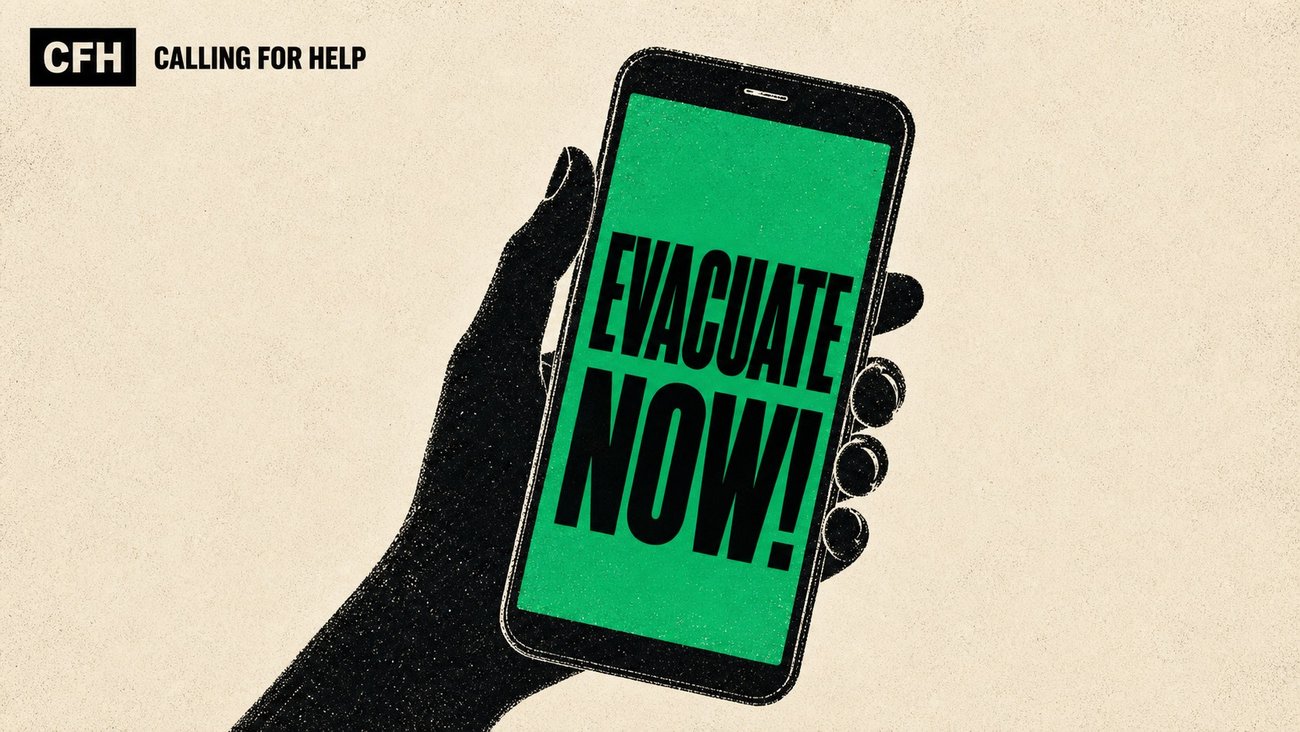
A woman’s hand holds a phone showing EVACUATE NOW! in heavy green block letters.
Why do we use Ai images? We don’t use photos of disabled refugees — their dignity, identity and safety come first. We’re powered by Ai and don’t spend funds on royalty payments for photos of refugees taken while in crisis.
Yasmin, 16 and Rohingya, was shot fleeing Myanmar. ‘It is very difficult to walk in the camp. I don’t have a cane,’ she told Human Rights Watch. Rohingya refugees aren’t legally allowed local SIM cards in Bangladesh, and many women in Cox’s Bazar don’t have safe access to a phone.
Sarah Al Deiry, 76, paralysed and Palestinian, died in late September 2024 waiting to be medically evacuated from Gaza. The UN Committee on the Rights of Persons with Disabilities found that destroyed communication networks had rendered evacuation impossible for disabled Palestinians: ‘Palestinians with disabilities fear being killed first.’
Every day another phone falls silent in another camp. Every day another disabled woman gets pushed further down a queue she couldn’t physically reach in the first place. For disabled women refugees, connection is protection.
There’s a digital disability gap. We close it with just £5.
Disabled women refugees are pushed to the back of every queue, physical and digital. Bombed roads, lost mobility aids, food queues they can’t fight through, latrines they can’t reach safely after dark, GBV centres twenty-five minutes through unlit alleys. They shouldn’t face a digital barrier on top of every other one. But without phone credit, every system that could still find them is out of reach — GBV hotlines, women-only clinic hours, family-tracing, antenatal SMS reminders, the cousin who’s been trying to wire bus fare for two weeks. A phone call is the first step to safety.
The best way to make people less poor is to give them money.
The best way to help disabled refugees is to give them phone credit.
So that’s what we do. Free mobile credit, direct to the phone of a verified disabled refugee, one person at a time. Anywhere a tower stands. Within minutes.
This is how we send Digital Humanitarian Aid to disabled refugees, one person at a time.
- AI triages every application. Hundreds screened in seconds. The same kind of model big firms use to catch fraud — pointed at finding the people who need help. No team of caseworkers needed, so more of every £5 reaches the recipient.
- Banks-grade biometric ID check. Sub-three-second liveness scan, catches deepfakes and replay attacks. The same standard banks use to open an account.
- Disability confirmed by the WHO standard. The global medical-aid methodology — the same questions the UN uses to count disabled refugees.
- Cleared against UK, EU, UN and OFAC sanctions databases. Every applicant, every time. The same list your bank checks before sending a transfer.
- A human gives final approval on every payout. Then the credit lands on the recipient’s phone in seconds — anywhere a tower stands, in 180+ countries. From approval to delivery of a lifeline in under 2 minutes.
Phone credit is more important than a wheelchair.
Aid in displacement is in short supply, and what does get through can’t reach everyone. Disabled women are always at the back of the queue — the ones aid workers can’t physically find, the ones whose phone is borrowed or controlled by someone else. A working phone she controls is the connection that brings her back into reach. The £5 we send becomes the call that puts one disabled woman refugee back in front of every aid system, every doctor, every GBV hotline, every family member, and every agency holding the wheelchair, prosthetic, or assistive device ready to be delivered.
£5 in phone credit is the most effective humanitarian aid.
We’re finding one disabled woman refugee at a time across every major crisis — the people other systems miss — and reaching them directly. The newsletter tells more of their story.
Read what £5 just unlocked.
One phone with credit unlocks every aid system around her. She needs it right now.
A working phone with credit isn’t aid in the usual sense — it’s the first move. From Khartoum to Kharkiv, from Cox’s Bazar to Adré, from Kakuma to Herat, it’s the connection that makes every other piece of aid reachable. Here’s what one phone can do for a disabled woman refugee:
- In Cox’s Bazar, where Rohingya refugees aren’t legally allowed SIM cards and many women lack safe phone access (GBV Sub-Sector), women classified ‘extremely vulnerable’ get no follow-up — nobody can reach them.
- In Adré, Chad, where 4,000+ GBV cases were recorded among Sudanese refugees and host populations in 2024 (UNHCR / Al Jazeera), a phone with credit reaches the GBV centre when walking through unlit alleys at night isn’t safe.
- In Sievierodonetsk, where wheelchair users like Olha Chernozhukova reached help via Telegram from a bomb-shelter basement (UNHCR Ukraine, 2022), a phone with credit is the lifeline that gets disabled women out under shelling.
- In Bamenda, Cameroon, where blind Anglophone students sleep on the streets after rejection by would-be hosts (HRW, 2019), a phone with credit lets a disabled woman find a DPO or shelter that will take her in.
- In eastern Chad, where ICRC’s Restoring Family Links has placed 1.4 million phone calls reuniting families separated by Sudan’s war (ICRC, 2025), a phone with credit puts a disabled mother back in touch with her children.
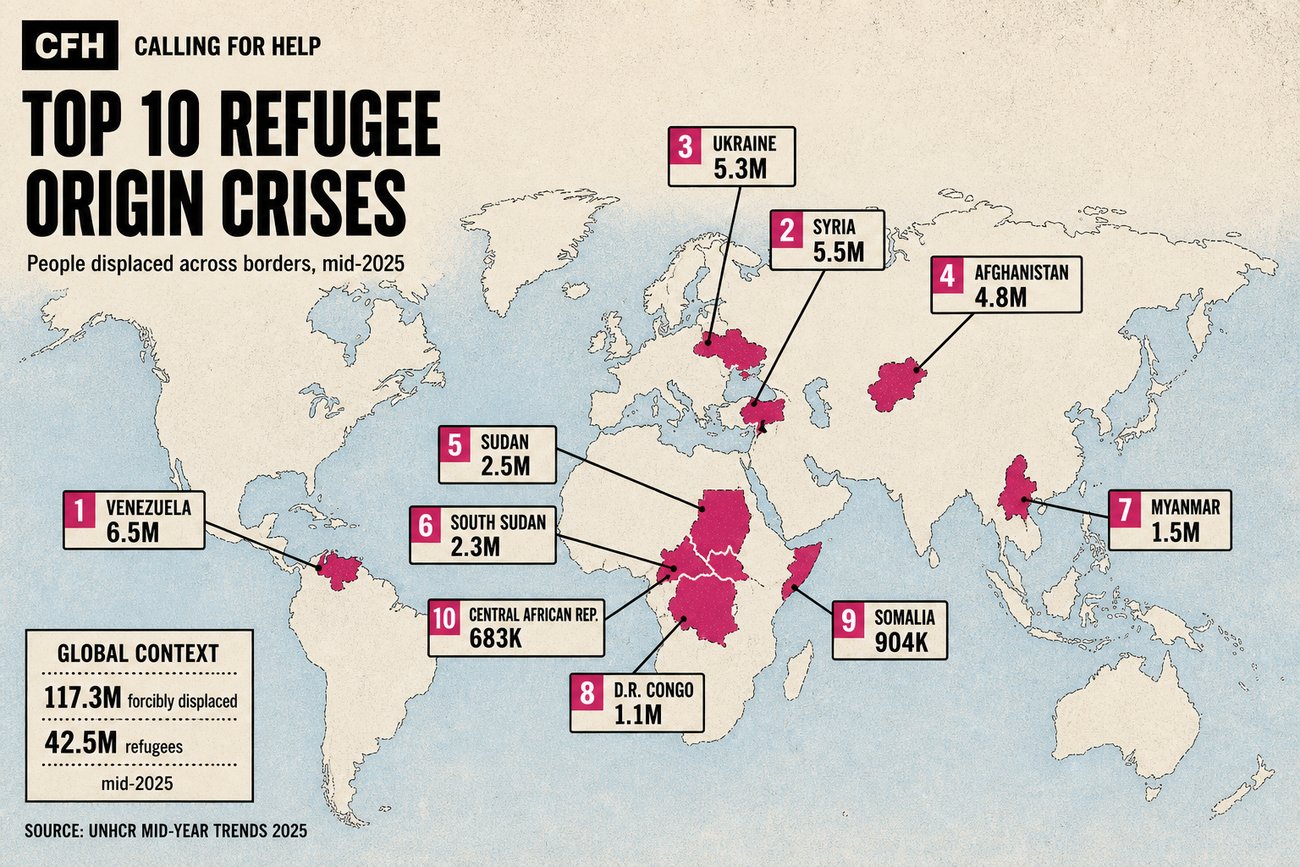
World map showing the top 10 refugee origin crises in mid-2025 — Venezuela 6.5M, Syria 5.5M, Ukraine 5.3M, Afghanistan 4.8M, Sudan 2.5M, South Sudan 2.3M, Myanmar 1.5M, DR Congo 1.1M, Somalia 904K, Central African Republic 683K, with global totals of 117.3M forcibly displaced and 42.5M refugees.
Why do we use Ai images? We don’t use photos of disabled refugees — their dignity, identity and safety come first. We’re powered by Ai and don’t spend funds on royalty payments for photos of refugees taken while in crisis.
Right now, there’s a list of disabled women refugees waiting for credit — across Sudan, Ukraine, Bangladesh, Chad, Kenya, and beyond. We’re working through it. Will you help us reach the next one?
Disabled refugees go unheard. Not in your inbox.
The Field Notes is our monthly dispatch from inside the work. Subscribing is the first way to stand with them.
- What £5 of credit reached, and what it unlocked for one verified person
- Live ops view — who we found, who’s still waiting
- First to know the moment donations open
No spam. Unsubscribe any time. We never share your data.
Help us close the digital divide one person at a time.